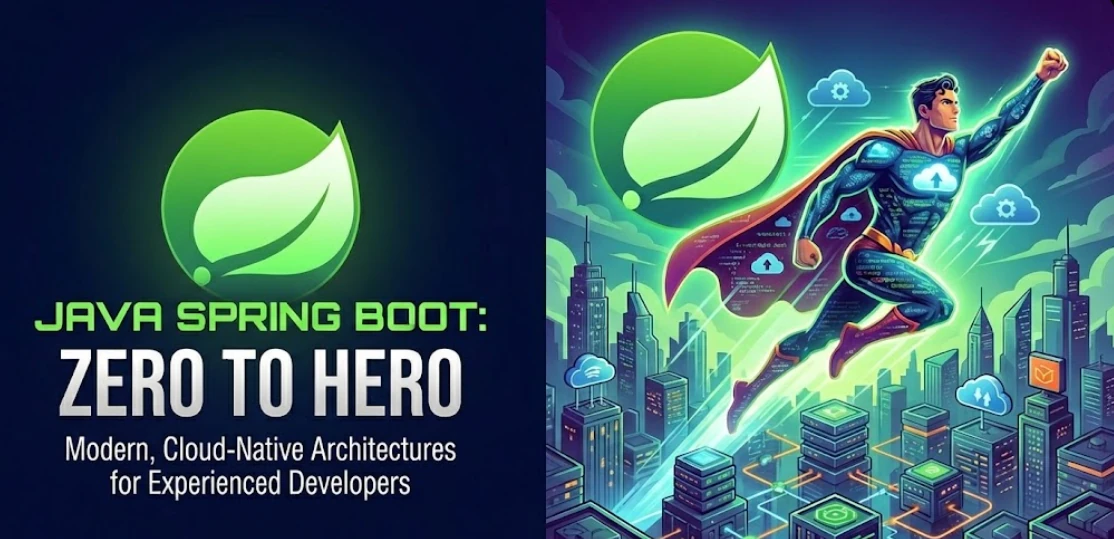
Spring Boot: From Zero to Superhero(English)
₺ 500.00₺ 200.00
Ürün Açıklaması
Book Title: Spring Boot: From Zero to Superhero
Subtitle: The No-Nonsense, Fun, and Complete Guide to Modern Java Development
---
Part 1: The Awakening (The Fundamentals)
Goal: Get the reader hooked, set up the environment, and explain the "Magic" without scaring them.
* Chapter 1: Why Spring Boot? (And Why You Should Care)
* The "Jar Hell" of the past vs. the Spring Boot revolution.
* Opinionated Defaults: Why Spring is like a helpful butler.
* Setting up your armory (JDK, IntelliJ/VS Code, Maven/Gradle).
* Chapter 2: Hello, World! (But Faster)
* Using Spring Initializr (The shopping list).
* Anatomy of the pom.xml / build.gradle.
* The Main Class: What does @SpringBootApplication actually do?
* Chapter 3: The Magic Box (Inversion of Control & Dependency Injection)
* The Analogy: Ordering pizza (Dependency Injection) vs. making it yourself.
* The Spring Context: The bucket that holds your objects.
* @Component, @Service, @Repository: The holy trinity of beans.
* @Autowired: Asking the container for help.
Part 2: Talking to the World (Building Web APIs)
Goal: Building the most common thing developers get paid for—REST APIs.
* Chapter 4: Speaking HTTP (RestControllers)
* The verbs: GET, POST, PUT, DELETE (explained using a coffee shop menu).
* @RestController vs. @Controller.
* Request Parameters vs. Path Variables: How to catch data from users.
* Chapter 5: The Bodyguard (Validation & Exception Handling)
* Never trust user input: Using @Valid and Bean Validation.
* The "Happy Path" vs. Reality.
* @ControllerAdvice: The global safety net for when things blow up.
* Chapter 6: JSON & The Jackson Five
* Serialization/Deserialization explained simply.
* DTOs (Data Transfer Objects): Why you shouldn't expose your internal organs (Entities) to the public.
Part 3: The Data Vault (Persistence & Databases)
Goal: Moving beyond memory and storing data permanently.
* Chapter 7: SQL & The Magic of JPA
* ORM explained: Translating Java objects to Database rows.
* H2 (The practice dummy) vs. PostgreSQL/MySQL (The real deal).
* Entities, IDs, and Generated Values.
* Chapter 8: Spring Data Repositories (Writing Zero SQL)
* The magic of findByNameAndEmail(): Query Methods.
* JPQL and Native Queries: When you need to get your hands dirty.
* Pagination & Sorting: Handling millions of records without crashing.
* Chapter 9: The Relationship Drama (One-to-One, One-to-Many)
* Mapping relationships correctly without creating infinite loops.
* Lazy vs. Eager loading: The silent performance killer.
* Chapter 10: Database Migrations (Flyway/Liquibase)
* Why "creating tables automatically" is bad for production.
* Version controlling your database schema.
Part 4: Guarding the Castle (Security)
Goal: The most intimidating topic, simplified.
* Chapter 11: Security Basics (The Bouncer)
* Authentication (Who are you?) vs. Authorization (What can you do?).
* The Default Security configuration (and how to turn it off).
* Chapter 12: Modern Security (JWTs & Stateless Auth)
* Why Sessions are so 2010.
* Implementing JSON Web Tokens (JWT) from scratch.
* Password Hashing (Bcrypt): Never store passwords in plain text!
* Chapter 13: OAuth2 & Social Login
* "Log in with Google/GitHub."
* The concept of Resource Servers and Clients.
Part 5: The Professional Touch (Testing & Observability)
Goal: Turning a "hacker" into a "software engineer."
* Chapter 14: Testing (Don't Push to Production on Friday)
* Unit Testing with JUnit 5 and Mockito.
* Integration Testing: @SpringBootTest.
* Testcontainers: Spinning up real databases in Docker for tests (Advanced but essential).
* Chapter 15: What’s Happening Inside? (Actuator & Logging)
* Spring Boot Actuator: The health check.
* Logs: SLF4J and why System.out.println is forbidden.
* Intro to Prometheus and Grafana (Visualizing your app's heartbeat).
Part 6: Going Supersonic (Advanced Topics)
Goal: Topics for Senior Developers.
* Chapter 16: Asynchronous Magic & Scheduling
* @Async: Fire and forget.
* @Scheduled: Running tasks while you sleep.
* Chapter 17: Events & Listeners
* Decoupling code using the Application Event Publisher.
* The Observer Pattern in practice.
* Chapter 18: The Reactive Revolution (Spring WebFlux)
* Blocking vs. Non-blocking I/O (The highway analogy).
* Monos and Fluxes: Introduction to Reactor.
* When to use WebFlux (and when to stick to MVC).
* Chapter 19: Caching Strategies
* Redis & @Cacheable: Making things lightning fast.
Part 7: The Microservices Maze (Architecture)
Goal: Understanding distributed systems.
* Chapter 20: Breaking the Monolith
* When (and when NOT) to use Microservices.
* Communication: Feign Client & RestTemplate.
* Chapter 21: Resilience (Resilience4j)
* Circuit Breakers: Handling failure gracefully.
* Retries and Rate Limiters.
* Chapter 22: Messaging (Kafka & RabbitMQ)
* Event-Driven Architecture basics.
* Producers and Consumers.
Part 8: The Launchpad (Deployment & DevOps)
Goal: Getting the code off the laptop and into the cloud.
* Chapter 23: Dockerizing Your App
* Writing a Dockerfile.
* Multi-stage builds for smaller images.
* Chapter 24: Cloud & Kubernetes Basics
* Deploying a JAR to the cloud.
* ConfigMaps and Secrets: Managing environment variables securely.
* Chapter 25: The Future (GraalVM & Native Images)
* Startup times of 0.1 seconds.
* Compiling Java to native machine code.
---
Appendix & Bonus
* The "Cheatsheet": Common Annotations explained in one sentence each.
* Common Interview Questions: How to pass a Spring Boot interview.
Preface: Why Another Spring Boot Book?
Let’s be honest for a second.
Learning Enterprise Java development can sometimes feel like trying to drink water from a firehose. You open the official documentation, and you are immediately hit with terms like "Inversion of Control," "Aspect-Oriented Programming," and "Dependency Injection." You look for a tutorial, and you find two types: the one that is too simple ("Here is how to print Hello World") or the one that is incredibly complex ("Here is how to architect a microservice mesh for a banking system").
There seemed to be a missing link—a guide that takes you by the hand, explains the why before the how, and actually treats you like a human being, not a compiler.
That is why I wrote this book.
I wrote "Spring Boot: From Zero to Superhero" because I believe that complex technology doesn't have to be boring. I believe that if you can understand how to order a pizza, you can understand Dependency Injection. If you can organize your kitchen, you can understand Database Normalization.
Who Is This Book For?
* The Absolute Beginner: You know a little Java (loops, classes, and objects), but the moment someone says "Bean," you get hungry rather than thinking about software architecture. This book will be your foundation.
* The "Tutorial Hell" Survivor: You’ve watched a dozen YouTube videos and copied code, but you don't really know how it works or why it works. This book will turn the "Magic" into logic.
* The Senior Developer: You’ve been coding for years, perhaps in older versions of Java or a different language entirely (like Python or Node.js). You want to get up to speed with Spring Boot 3, Native Images, and Kubernetes without wading through fluff.
What Will You Learn?
We are going to go on a journey. We will start with the basics—wiping away the confusion of configuration. We will move into building real-world APIs, securing them (because the internet is a dark place), and talking to databases.
But we won’t stop there. By the end of this book, you won’t just be writing code; you will be shipping it. We will dive into Docker, Kubernetes, Cloud deployment, and high-performance coding with Reactive programming.
My Promise to You
My goal is simple: I want to respect your time. I won't bore you with academic theory that you will never use in a real job. Every chapter in this book is designed to answer a specific question: "How do I use this to build something real?"
By the time you turn the final page, you won't just know Spring Boot—you will understand it. You will look at a complex codebase and think, "I know exactly what's going on here."
So, grab a fresh cup of coffee, fire up your IDE, and let’s get to work. It’s time to become a Superhero.
Let’s code.
Ali Turgut Bozkurt
December 2025